Frequently Asked Questions
Please contact info@md.catapult.org.uk if your question is not answered in the following FAQ.
Q: How do I get access to login credentials for the kibana dashboard feature?
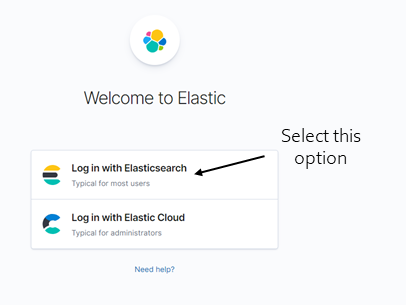
The kibana dashboard currently requires login credentials to access. Please contact MDC to request these. Once you have a set of login credentials, select the Log in with Elasticsearch option:
Q: The kibana dashboard feature does not appear to load properly in my web browser after entering login credentials?
Please contact MDC for support including full details of your web browser version.
Q: How do I interact with the kibana dashboard?
The following schematic illustrates how to perform a series of property filtering steps. Initially, when the dashboard is accessed, the full set of 1625 unique drug entities (prior to any filtering) will be visible in the dashboard, as is seen in the top left of the screenshot below:
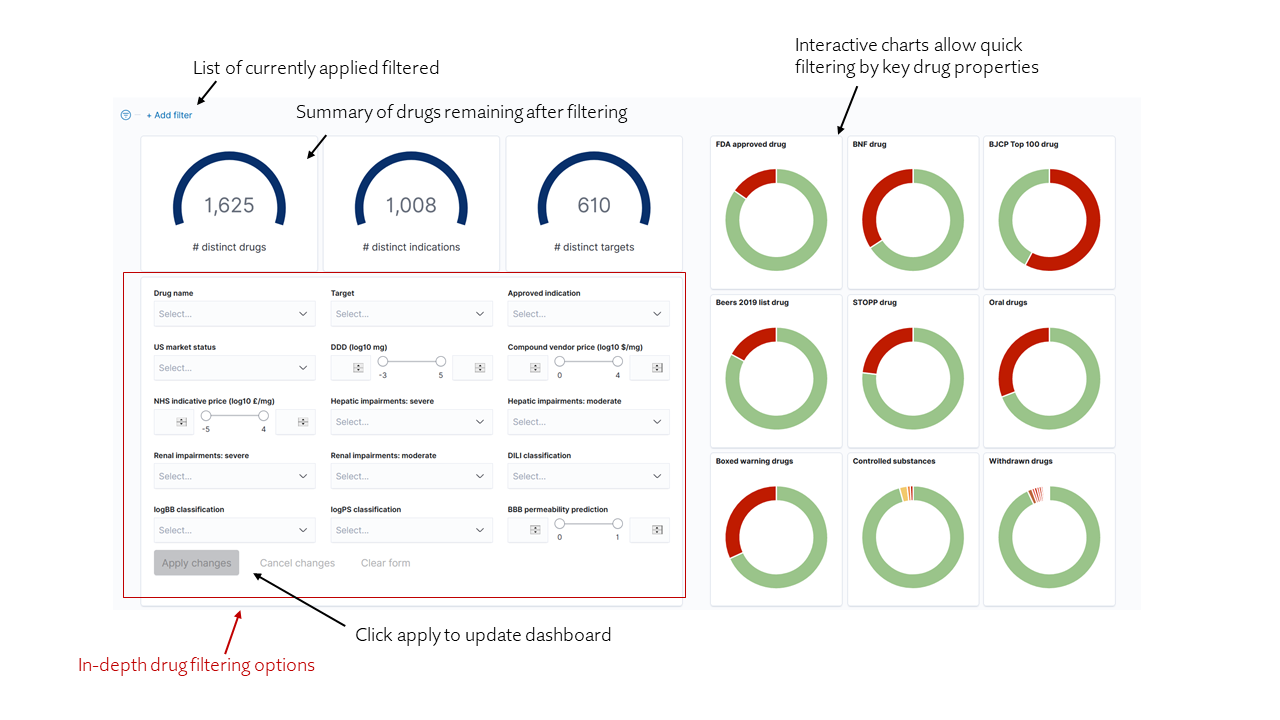
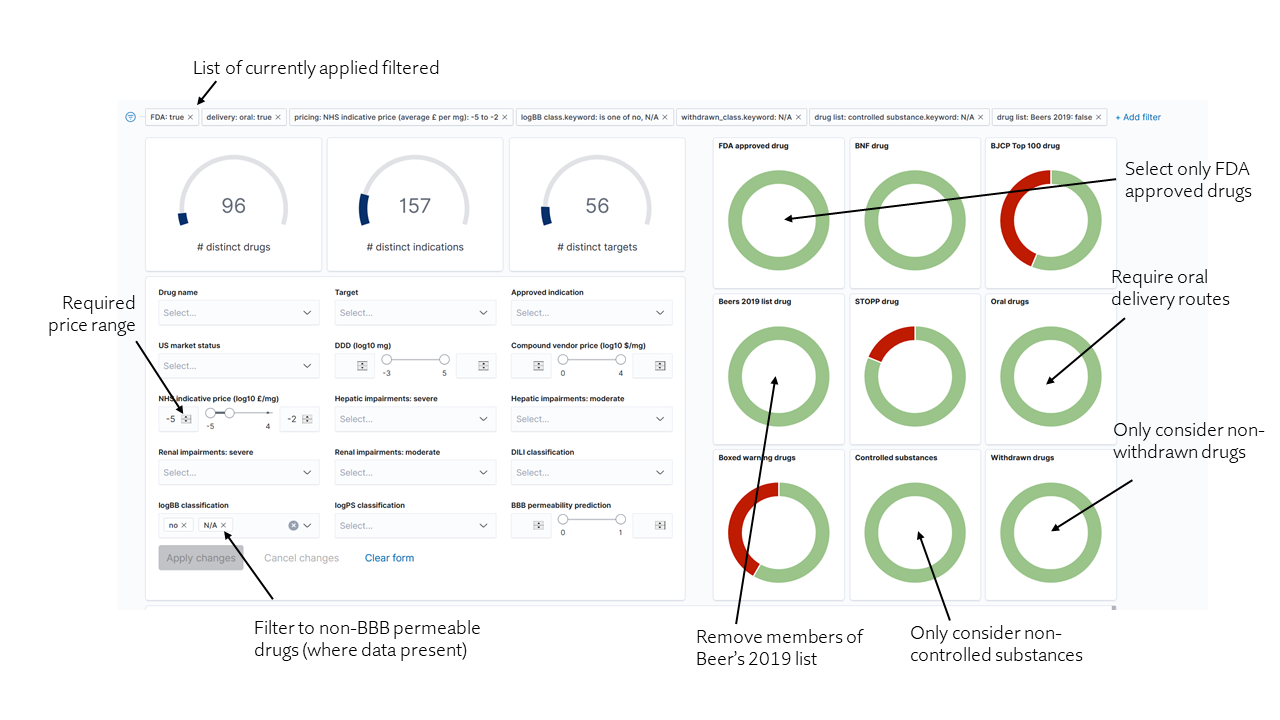
In the following schematic, several filtering steps have been performed. A subset of these filters (e.g. FDA drug approvals, requirement for oral delivery routes) have been applied by directly clicking on the relevant subsection of each interactive plot in kibana. The remainder of the filters have been applied by modifying the in-depth drug filtering control panel (highlighted in red in the above screenshot). As an important note, the kibana dashboard plots will update in real-time if any selections are made by clicking the plots directly. If a plot is accidentally modified, the corresponding filter can be removed manual from the top of the dashboard:
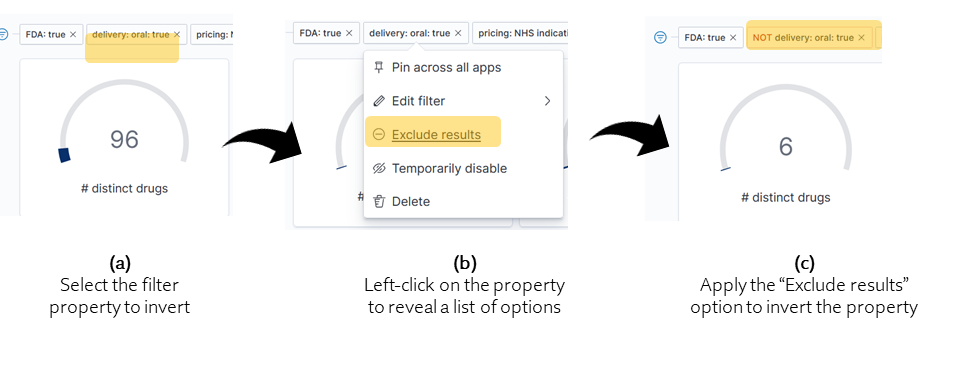
The filtering options provided by kibana are limited in their flexibility, and it may be that inverse of a selected filter is desired. This can quickly be achieved in kibana by directly modifying the filter at the top of the dashboard:
Q: Is the data accessible for download?
Subsets of data underlying each interactive plot within the kibana dashboard can be directly downloaded directly from each plot. The full underlying dataset will also be made available for download in future.
Q: What drug entities are included in the dashboard?
A comprehensive set of approved drug entities (along with associated pharmacological class information) was first compiled by taking the union of drug therapies published within the British National Formulary (BNF), DailyMed, FDA’s orange book and the WHO’s ATC/DDD index 2020. To account for drug naming heterogeneity between data sources, all identified drug names were grounded to distinct FDA Substance Registration System UNII identifiers and corresponding preferred name terms. All salt forms of a drug have been resolved to a single active moiety within the dashboard, such that each distinct "drug" instance reported in the dashboard may correspond to multiple distinct chemical entities/UNII identifiers.
Q: Does the dashboard include drug combination data?
Due to the complexity in attributing particular adverse effects to individual components within drug combination therapies, products containing multiple active ingredients were identified through regex pattern matching, and these have been omitted from the current analysis.
Q: Which data sources have been used for data present in the dashboard?
| Data source | URL | Data type |
|---|---|---|
| SIDER | http://sideeffects.embl.de/ | Adverse effects per drug & prevalence information |
| BNF | https://bnf.nice.org.uk/ | Adverse effects, hepatic & renal warnings, drug-drug interactions, dosing information |
| DailyMed | https://dailymed.nlm.nih.gov/dailymed/ | Adverse effects, hepatic & renal warnings, drug-drug interactions, dosing information |
| gov.uk | https://www.gov.uk/government/publications/controlled-drugs-list--2 | UK Controlled drug lists |
| ATC/DDD index | https://www.whocc.no/atc_ddd_index/ | Defined daily dosing, administration routes, drug classifications |
| FDA Orange Book | https://www.accessdata.fda.gov/scripts/cder/ob/index.cfm | Administration routes, number of products, discontinued product information, product strengths |
| Beer's 2019 criteria | https://geriatrictoolkit.missouri.edu/drug/Beers-Criteria-AGS-2019.pdf | Inappropriate drug listings and criteria |
| STOPP/START criteria version 2 | https://academic.oup.com/ageing/article/44/2/213/2812233 | Inappropriate drug listings and criteria |
| FDA SRS | https://fdasis.nlm.nih.gov/srs/srs.jsp | Unique Ingredient Identifiers (UNII) | Inxight: Drugs | https://drugs.ncats.io/ | Approved indications & associated targets | Drugs@FDA | https://www.accessdata.fda.gov/scripts/cder/daf/index.cfm | FDA-approved drugs, FDA approval years | WITHDRAWN | http://cheminfo.charite.de/withdrawn/ | Drug withdrawal data |
Q: What drug safety data has been included in the dashboard?
Published drug lists:
Commonly identified non-suitable therapies for geriatrics were identified from Beer’s list (2019 version) and the 2015 STOPP/START criteria set. In cases where drug classes were specified (e.g. anticholinergics) instead of explicit drug instances, these were mapped to specific drugs using the pharmacological subgroups within the WHO ATC classification system.
Extension of published drug lists:
For each drug reported within Beer’s list and the STOPP list, a reason for drug inappropriateness has been manually extracted. In cases where the reason involved a specific adverse effect was to be avoided, the associated adverse effect terms have been grounded to medical subject headings (MeSH) disease codes using the NextMove Sofware LeadMine, and these MeSH codes have been used to identify additional therapies to be flagged as unacceptable through the same reasoning. To achieve this, adverse effect and contra-indication data published by the British National Formulary (BNF), DailyMed, and the SIDER v 4.1 database, were also resolved to MeSH disease codes using LeadMine, such that overlaps with the criteria underlying Beer’s list and STOPP/START could be efficiently detected.
Adverse effects:
As discussed in the above section, adverse effect information per drug has been aggregated across various prescribing sources. Where possible, the prevalence of each adverse effect has been identified from the original sources, in order to distinguish between common, infrequent and rare side effects within the dashboard. In addition, FDA boxed warning information, indicative of the risk of serious life-threatening adverse effects, were identified within the DailyMed XML data associated with each drug product. A high risk is associated with prescribing such products as treatments for the elderly.
Drug withdrawal information:
Drugs that have been withdrawn in one or more country were identified using the WITHDRAWN database, including an annotated toxicity type for each drug, corresponding to the safety reason for each drugs’ withdrawal. These drugs may still be available in a subset of countries, but are anticipated to have limited drug repositioning potential, due to known safety concerns.
Controlled substances:
A list of class A, B and C controlled substances (defined by UK law) has been compiled through GOV.UK, corresponding to the Misuse of Drugs Act 1971 and the Misuse of Drugs Regulation 2001. These substances are likely to be inappropriate as viable treatments for the aging population, due to limited access and propensity towards addiction.
Hepatic and impairment warnings:
Drugs with explicit warnings for individuals with either renal or hepatic impairments were identified in the BNF and DailyMed prescribing information. Due to the high heterogeneity in text content across product labels, word frequency analysis has been performed over the relevant impairment warning sections of all flagged products in order to further distinguish whether each drug should be (a) strictly avoided, (b) used with caution/under monitoring, or (c) safe to use under lowered dosage regimen.
In addition, the DILI (Drug Induced Liver Injury) classification per drug has been extracted from the Liver Toxicity Knowledge Base (LKTB), which consists of 1036 FDA-approved drugs that are divided into 4 classes (most-DILI-concern, less-DILI-concern, no-DILI-concern, ambiguous-DILI-concern) according to their potential for causing DILI.
Drug-drug interactions:
Drug-drug interactions (DDIs) have been extracted from the BNF and supplemented with additional interactions detected using the NextMove Software LeadMine within the "Drug Interactions" section of DailyMed prescribing labels, for cases where no BNF information was available. Conflicts with commonly prescribed geriatric medicines have then been flagged: here a list of common geriatric medicines has been collated by taking the union of (a) the START v2 listing of appropriate therapies for older persons, (b) the set of common treatments that have been highlighted as having inappropriate drug-drug interactions (DDIs) with members of Beer’s 2019 list, and (c) treatments identified through the anonymised treatment prescribing counts through the NHS Business Services Authority (BSA) web portal, using monthly demographic data to identify the subset of practices in England for which over 50% of patients were over the age of 75.
Blood-brain barrier permeability data:
Where possible, experimentally-derived measurements of blood-brain barrier (BBB) permeability have been extracted from published literature, as logBB (the concentration of drug in the brain divided by concentration in the blood) and logPS (permeability–surface-area product) values. For drugs for which no such experimental data has been located, predictive modelling has been used to provide a prediction of the probability of BBB permeability, using supervised machine learning models trained using all available experimental logBB and logPS data. In addition, for each drug for which a BBB prediction has been made, the maximum chemical similarity of the drug to all compounds within the logBB and logPS model training sets has been computed. As such, model predictions that are made for drugs that are chemically-remote from the model training data set can be identified.
Q: How has the drug dosing information in the dashboard been acquired?
Available drug administration routes have been collated from the BNF, FDA’s orange book and ATC/DDD index 2020. To mitigate any discrepancies in delivery route terminology between sources, a custom LeadMine resolver has been constructed to map routes to one of eleven classes: {oral, topical, parenteral, rectal, respiratory, nasal, vaginal, urethral, eye, ear, other}. Since oral administration of drugs is highly preferable to ensure good elderly compliance with a drug regimen and mitigates tissue irritation and bruising associated with long-term parenteral administration routes, the dashboard currently features an option to filter for orally-delivered drugs.
Defined daily dosing (DDD) data has been extracted from WHO’s ATC/DDD index 2020, and drugs with high daily dose requirements can be filtered out using the dashboard.
Q: How has the drug pricing information in the dashboard been acquired?
UK product pricing information has been extracted from the NHS BSA web portal, with a £/mg Tariff price being calculated here for each product, whilst accounting for different product forms and strengths. A £/day cost associated with each drug has also then been calculated by using ATC/DDD index defined daily dosing mg values (see above section on DDD).
In addition, compound pricing information ($ per mg) was collated from the mcule online drug discovery platform, to indicate how relatively available/viable each compound would be for use in pre-clinical studies.